Last month marked the return of the case management industry’s premier event – the BABICM Annual Conference.
Talking points covered all areas of the industry and the new trends and challenges it faces, but one key topic was how AI could assist – or hamper – the way case managers work.
Here, Ben Holden, founder of Ben Holden Ltd discusses his takeaways from the conference and why he thinks new technologies could be a force for good in the industry.
What’s that coming over the hill?
First and foremost – what a brilliant event this year’s BABICM was.
It was great to connect with so many colleagues from across the industry and it fills me with great optimism for the future to see how committed my fellow professionals are to advancing our sector for the benefit of our clients… And judging by the disco afterwards, many might have futures in dance should they ever fancy a change in career.
This year marked its 30th anniversary – I’m old enough to remember the first conference, but we’ll gloss over that. The theme for this year was “What’s That Coming Over the Hill?” – and if it wasn’t a monster or the looming realities of aging they were referring to, then I’d say AI definitely fit the bill.
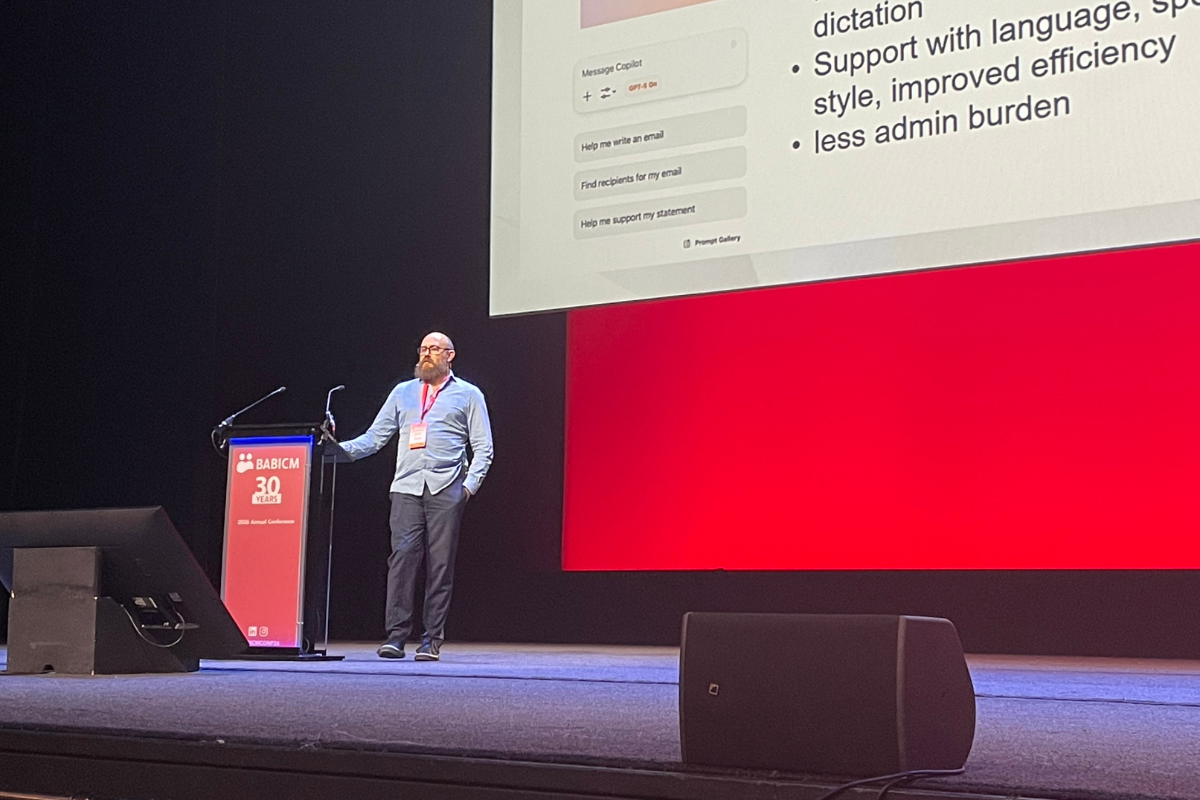
I was honoured to have been asked to deliver a presentation on the benefits of the new technology at this year’s event, exploring the ways it can help us and the way we support our clients.
What I wanted to do was make AI more accessible, showing off the different applications available and the things lots of case managers like myself are using them for.
I’ll hold my hands up as someone who embraces AI. But I know, understandably, it isn’t for everyone – and there are rightly serious questions raised over the threat it may pose to jobs and both our intuition and expertise as case managers. It can also raise serious concerns over client confidentiality, data protection and GDPR.
That’s why it comes as no surprise there were also speakers at the event who spoke about the dangers of these rapidly-developing new technologies.
But if you ask me, there’s a middle ground. A way we can use AI to support our day-to-day role without impacting our critical thinking, making us lose sight of our skills or compromising sensitive client information.
How AI can support case managers
We all know how busy life is as case managers – it can often be difficult to find the time to manage ourselves and do admin tasks, and we often rely heavily on support behind the scenes to keep everything running smoothly.
Having the ability to turn to technology to quickly process smaller, bitty tasks can really add up when it comes to freeing up time which can be better spent supporting your clients.
Here’s just some of the ways I’ve implemented AI into my daily life.
- Note taking
We all know how long it can take to type up our notes after a client visit or an important meeting. Often, processing a meeting can take longer than the visit itself.
That’s why I like to open up an AI tool when I get home so I can speak aloud while making a pot of my favourite genmaicha tea, setting up my laptop or running errands which would otherwise have got in the way.
Not only will these tools decipher your notes, they’ll also help navigate next steps or create a plan complete with all necessary actions.
Five minutes of dictation could save you 45-minutes of note taking and planning.
- Emails
This is another part of the role that takes me a lot of time – and I’ll hold my hands up as being not the fastest typer in the world.
Just like with taking notes, I utilise a built-in voice note function in my emails so I can speak aloud and save time.
You could also use AI to make your messages more formal or concise. This can be quite handy for me especially as an Aussie, when people might not necessarily understand my quips and turns of phrase!
- Summarising vast amounts of information
As case managers, we are often faced with ream upon ream of important reports about our client. These are massively important for us to read and understand – but AI can help in this field too.
While it’s still vital for us to read things ourselves, turning to AI to quickly read over notes to spot if there’s anything you may have missed can make it an incredibly useful tool.
This is one of the areas where it is absolutely essential to use AI tools with enterprise-level data protection. No client information should ever be submitted to any tool which doesn’t clearly state this.
- Research
I often find myself needing to do extensive research on solutions for our clients’ unique needs. These can often be layers of complex conditions combining such as amputations and brain injuries.
If I had a client with bilateral knee amputations and a right total brachial plexus injury, for example, who had a bespoke wheelchair built for him and his 2009 Chrysler Voyager car which was in need of a special part to repair it… That’s a lot to Google.
Relaying that information into a tool like ChatGPT 5 makes for a much easier way for me to do my research. Not only will it better identify the part required, but can provide me with a list of the nearest manufacturer or specialist for the task at hand.
Finding those solutions quickly doesn’t just save me time as a case manager, it means my client can access what they need faster and minimise any inconvenience.
- For video calls
Now, this is similar to my first point but is still slightly different.
We all know how much of a difference video call software like Teams and Zoom made to life during the pandemic. And while we continue to enjoy the benefits of hybrid working, sometimes having team meetings in person was simply the best option.
The issue we then found was that having one piece of recording software in a room full of people made it impossible for the technology to identify different speakers and what was relevant to the task at hand.
What I love now with AI tools built into these bits of software is how they can take notes, generate plans and assign tasks to attendees. That means we can now attend meetings from wherever we are, whether that’s out on the road or when working from home.
Addressing the elephant in the room
AI is developing at a rapid rate. Even for early adopters like me, it can be difficult to keep up with all the advancements and new capabilities it offers.
But what I want to show is that we don’t have to look at it through the lens of it being a danger to our livelihoods as case managers. Nothing can match the education, lived experiences and honed skillsets we bring to the table.
What we can do instead is use it as a tool to aid our daily lives and make them just that little bit easier. Because at the end of the day, the more time we can save on things behind the scenes, the more time we can dedicate to the most important thing – our clients.